Bracing for Impact: True Tales of Air Disasters and the People Who Survived Them by Robin Suerig Holleran & Lindy Philip
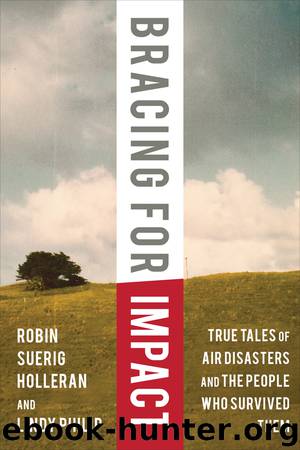
Author:Robin Suerig Holleran & Lindy Philip [Holleran, Robin Suerig & Philip, Lindy]
Language: eng
Format: epub
Tags: Transportation, Aviation, Commercial
ISBN: 9781510700321
Google: NwQQCwAAQBAJ
Amazon: B0175P7POG
Publisher: Skyhorse
Published: 2015-10-26T16:00:00+00:00
COCKPIT RESOURCE MANAGEMENT
The 1978 Portland crash changed the dynamics of the airline industry forever for the better and was highlighted on a National Geographic television series segment named Fatal Fixation that included interviews with Aimee and an actress playing her as a teenager in the reenactment.
The head pilot of Flight 173 was very experienced. He’d been with United Airlines for twenty-seven years and had logged more than 27,000 hours in the air by the time of the accident, 5,500 of which as a DC-8 captain. In addition, the first officer and flight engineer had thousands of flying hours between them. It was hard for anyone to understand how the crash could have happened, how such an experienced pilot could have circled within sight of a major airport for an hour without being able to land safely.
In the 1970s, the culture in a cockpit was driven by the hierarchical authority of the captain, many of whom were described as cocky and arrogant as one would imagine an ex-military Top Gun pilot might be. Challenging a captain’s reasoning about something as basic as fuel would have been extremely difficult, even when a preoccupation with a landing gear issue was obviously blinding him to the impending emergency.
Aviation expert Dr. Alan Diehl served on the crash investigation team as the NTSB Human Factors Group cochairman. He recommended the implementation of a new program that was being developed by NASA called Cockpit Resource Management (CRM) training. CRM would improve teamwork and collective decision-making, especially at times of crises when no one person could possibly be cognizant of all potential threats to the safety of a flight.
It was not a hard sell. The Ames Research Center at NASA was already researching training concepts to reduce human error and improve safety. According to their research, poor communication and teamwork in decision-making processes was a contributing factor in over 70 percent of all airline accidents. Two prime examples around this time were the Eastern Airlines crash in the Everglades in 1972 that killed 101 people and the collision of KLM and Pan Am jets on a runway in the Canary Islands in 1977 that killed 585 people.
Over the years, a number of programs have evolved to improve communications on civilian and military planes and helicopters. Studies have shown that these techniques have significantly reduced accident rates by as much as 81 percent.
The underlying concepts of CRM have also been adopted in some countries to help overcome cultural barriers of excessive politeness and/or reluctance to challenge authority that could shroud a dangerous situation.
CRM was put to the test on July 19, 1989. The collaborative environment in the cockpit of United 232 was credited for avoiding a total loss of life (185 of the 296 people onboard survived) when the plane crash-landed in Sioux City, Iowa, without the use of conventional control systems.
In CRM-style programs, participants acquire tools to help prevent common errors that can arise from other distractions. Leadership, teamwork, and defined responsibilities are emphasized along with other skills
Download
This site does not store any files on its server. We only index and link to content provided by other sites. Please contact the content providers to delete copyright contents if any and email us, we'll remove relevant links or contents immediately.
Still Foolin’ ’Em by Billy Crystal(36468)
We're Going to Need More Wine by Gabrielle Union(19168)
Plagued by Fire by Paul Hendrickson(17537)
Pimp by Iceberg Slim(14795)
Molly's Game by Molly Bloom(14259)
Becoming by Michelle Obama(10111)
When Breath Becomes Air by Paul Kalanithi(8590)
Educated by Tara Westover(8173)
The Girl Without a Voice by Casey Watson(7976)
The Incest Diary by Anonymous(7826)
Note to Self by Connor Franta(7749)
How to Be a Bawse: A Guide to Conquering Life by Lilly Singh(7613)
The Space Between by Michelle L. Teichman(7031)
What Does This Button Do? by Bruce Dickinson(6315)
Permanent Record by Edward Snowden(5959)
Imperfect by Sanjay Manjrekar(5936)
A Year in the Merde by Stephen Clarke(5521)
Shoe Dog by Phil Knight(5391)
Heated Rivalry by Rachel Reid(5265)
